Skip to content

Technical Blog

One Camera Leaves Gaps. Five Cameras Reveal the World.

A depth camera doesn't take a photograph. It builds a world — a dense cloud of points in 3D space, each one a precise distance measurement. Every surface, every edge, every object reduced to its position in space.

It's a remarkable way to see. The problem is the gaps.

A single camera captures what's directly in front of it. Everything else — the far side of an object, the space behind a surface, anything outside its field of view — simply doesn't exist in its picture of the world. Those invisible regions aren't a minor inconvenience. They're the difference between a system that understands a scene and one that only thinks it does.

That was true right up until multi-camera fusion stopped being a research problem — for a rig with its camera poses already known, it became a setup measured in minutes.
You Can Now Tell a Robot to Move — Powered by AgenticROS, NemoClaw, and the AVerMedia SenseEdge Development Kit

Say "move forward" to most AI-powered robots today, and nothing happens.

Not because the AI didn't understand you. It did. The model can parse the sentence, recognize the intent, even hold a conversation about what it plans to do next.

The robot just doesn't move — because understanding a command and acting on it are two completely different problems.

Accelerating Edge AI: Simplifying Camera Integration with AVerMedia

If you are developing an AI vision system, an autonomous mobile robot (AMR), or an edge-computing solution on a NVIDIA Jetson platform, camera-driver integration often becomes a bottleneck. Between sensor interfaces, kernel modules, device-tree overlays and tuning, teams can spend significant time just bringing up a simple camera feed. With AVerMedia’s Jetson-based systems the process is markedly streamlined. AVerMedia delivers camera drivers already integrated into its BSP (board-support-package) for Jetson modules so you can connect a supported camera and shift your focus quickly to perception, AI and deployment rather than low-level driver porting.

AI on the QL601: Bringing Your Models to Life Fast with LiteRT on Python


Imagine you’ve trained an amazing AI model on your workstation. Now, it’s time for it to shine on the QL601 edge device. Whether you want HTP acceleration, GPU power, or just CPU execution, LiteRT on Python makes this transition seamless.

Deploying AI models to edge devices often means rewriting your entire pipeline, learning new frameworks, or accepting significant performance compromises. But what if you could keep your Python workflow intact while unlocking 10-20x performance gains?

LiteRT acts as the bridge between your existing Python workflow and Qualcomm’s optimized hardware. Instead of rewriting your pipeline, you convert your model to TFLite, attach the LiteRT delegate, and keep your preprocessing, postprocessing, and business logic intact. With only minor changes to the inference step, your Python app can continue running on your laptop or in the cloud while the QL601 handles fast, edge-ready inference.

LiteRT doesn’t rewrite your story—it simply makes your model run faster in the real world.

QL601: Precision Green Screen & Seamless CDN Streaming

As demand for video processing and live streaming continues to rise, developers need platforms that combine high performance with customizable media pipelines.

Through cross-compilation and GStreamer plugin development, green-screen removal on QL601 with Vulkan shaders enables real-time 1080p60/4Kp30 streaming to CDN platforms such as Twitch and YouTube — all built on the same development flow established for QL601.

The following sections detail the complete workflow, from environment setup and plugin development to real-time streaming deployment.

Benchmark SUPER mode of NVIDIA Jetson Orin NX

In 2025, AI is undoubtedly the hottest topic today, and there are many application scenarios that require localized deployment, such as smart surveillance systems, intelligent retail stores, and small-scale robots with LLM/VLM.

The NVIDIA Jetson Orin NX is a compact, high-performance AI computing module designed for edge applications such as robotics, smart cameras, and industrial automation. It delivers up to 157 TOPS of AI performance using the NVIDIA Ampere architecture, making it ideal for running complex AI models locally with low latency and high efficiency.

To unlock its full potential, the AVerMedia D133S Carrier Board provides a robust and versatile platform tailored for the Orin NX. It supports super mode for enhanced performance and offers a rich set of I/O.

Here, we are going to introduce and benchmark these two powerful standard carrier boards(D133 and D133S) from AVerMedia, which offer rich I/O options such as camera inputs, multiple Ethernet ports and a GPU, making them especially suitable for AI edge computing applications.

Virtual Media for Out-of-Band Management

OOB, or Out-of-Band Management, refers to a method of managing systems via a dedicated management channel that operates independently of the host operating system. This means administrators can manage the system even when the OS is unresponsive. It allows IT administrators to perform essential tasks such as rebooting devices, managing powered-down equipment, and resolving network issues without needing physical access. OOB management is crucial for maintaining network uptime and accessibility in large, distributed, or remote environments by providing a secure, always-on management channel independent of the operational network.

Virtual Media is a technology that allows users to access or map remote storage devices—such as ISO files, CD/DVDs, and USB drives—to a edge device as if they were physically connected to the edge device's USB port. This enables remote tasks like installing operating systems, performing firmware upgrades, transferring files, and running diagnostics.


Accelerate VLM Development with AI Fusion Kit

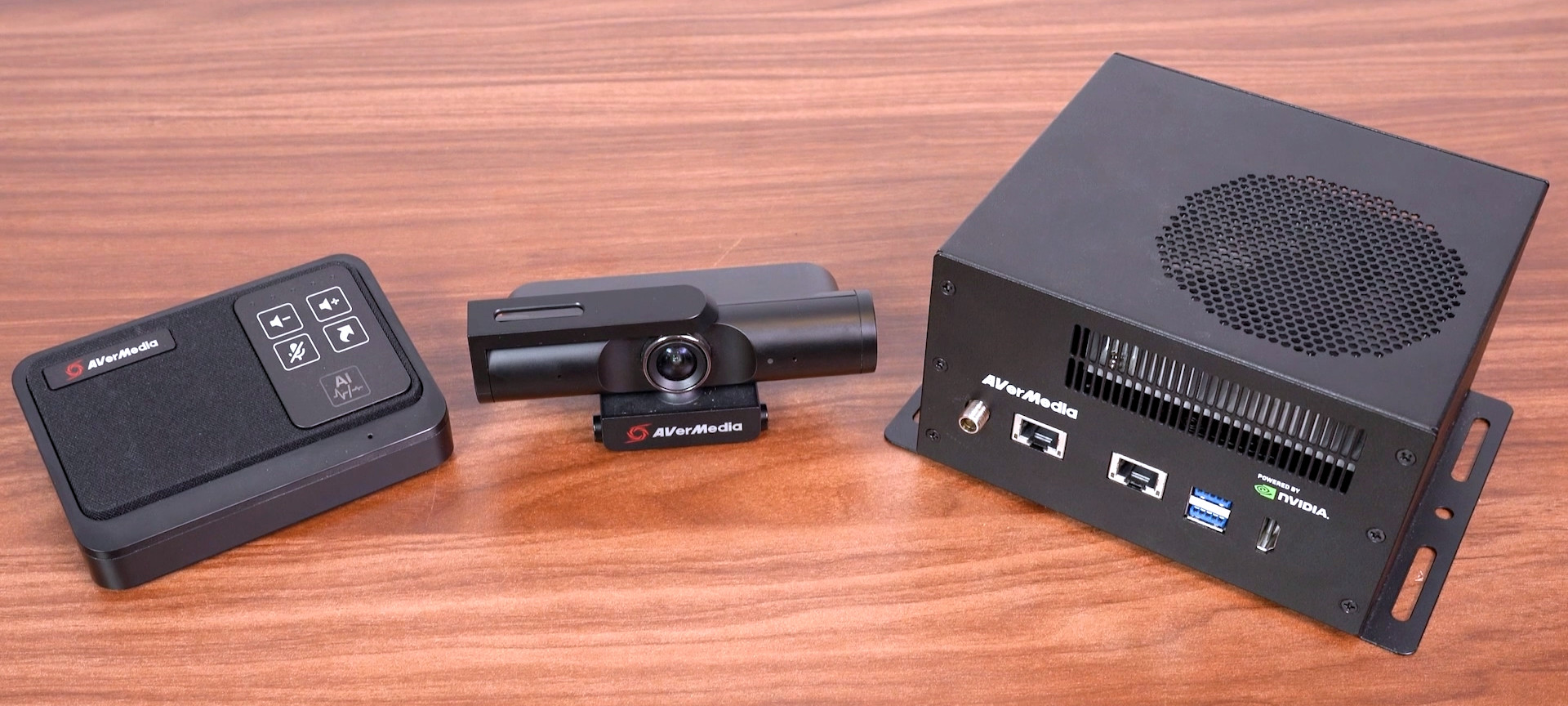
AI Fusion Kit

The first barrier in any multimodal LLM project is often not about the model itself, but about the hardware. Looking for a powerful computing platform, a high-quality camera, and a sensitive microphone can take a lot of time and effort. What's worse, these components may not work well together, leading to a tangled web of driver issues, compatibility conflicts, and frustrating debugging sessions before your real work even begins.

The AI Fusion Kit is designed to eliminate these challenges entirely. It is a complete, out-of-the-box solution where every component works seamlessly together.