Say "move forward" to most AI-powered robots today, and nothing happens.
Not because the AI didn't understand you. It did. The model can parse the sentence, recognize the intent, even hold a conversation about what it plans to do next.
The robot just doesn't move — because understanding a command and acting on it are two completely different problems.
NVIDIA Isaac GR00T turns a modest set of hand-guided demonstrations into an arm that runs the task on its own. Here's how the whole thing fits together, and the trade you're making.
If you are developing an AI vision system, an autonomous mobile robot (AMR), or an edge-computing solution on a NVIDIA Jetson platform, camera-driver integration often becomes a bottleneck. Between sensor interfaces, kernel modules, device-tree overlays and tuning, teams can spend significant time just bringing up a simple camera feed. With AVerMedia’s Jetson-based systems the process is markedly streamlined. AVerMedia delivers camera drivers already integrated into its BSP (board-support-package) for Jetson modules so you can connect a supported camera and shift your focus quickly to perception, AI and deployment rather than low-level driver porting.
In 2025, AI is undoubtedly the hottest topic today, and there are many application scenarios that require localized deployment, such as smart surveillance systems, intelligent retail stores, and small-scale robots with LLM/VLM.
The NVIDIA Jetson Orin NX is a compact, high-performance AI computing module designed for edge applications such as robotics, smart cameras, and industrial automation. It delivers up to 157 TOPS of AI performance using the NVIDIA Ampere architecture, making it ideal for running complex AI models locally with low latency and high efficiency.
To unlock its full potential, the AVerMedia D133S Carrier Board provides a robust and versatile platform tailored for the Orin NX. It supports super mode for enhanced performance and offers a rich set of I/O.
Here, we are going to introduce and benchmark these two powerful standard carrier boards(D133 and D133S) from AVerMedia, which offer rich I/O options such as camera inputs, multiple Ethernet ports and a GPU, making them especially suitable for AI edge computing applications.
The first barrier in any multimodal LLM project is often not about the model itself, but about the hardware. Looking for a powerful computing platform, a high-quality camera, and a sensitive microphone can take a lot of time and effort. What's worse, these components may not work well together, leading to a tangled web of driver issues, compatibility conflicts, and frustrating debugging sessions before your real work even begins.
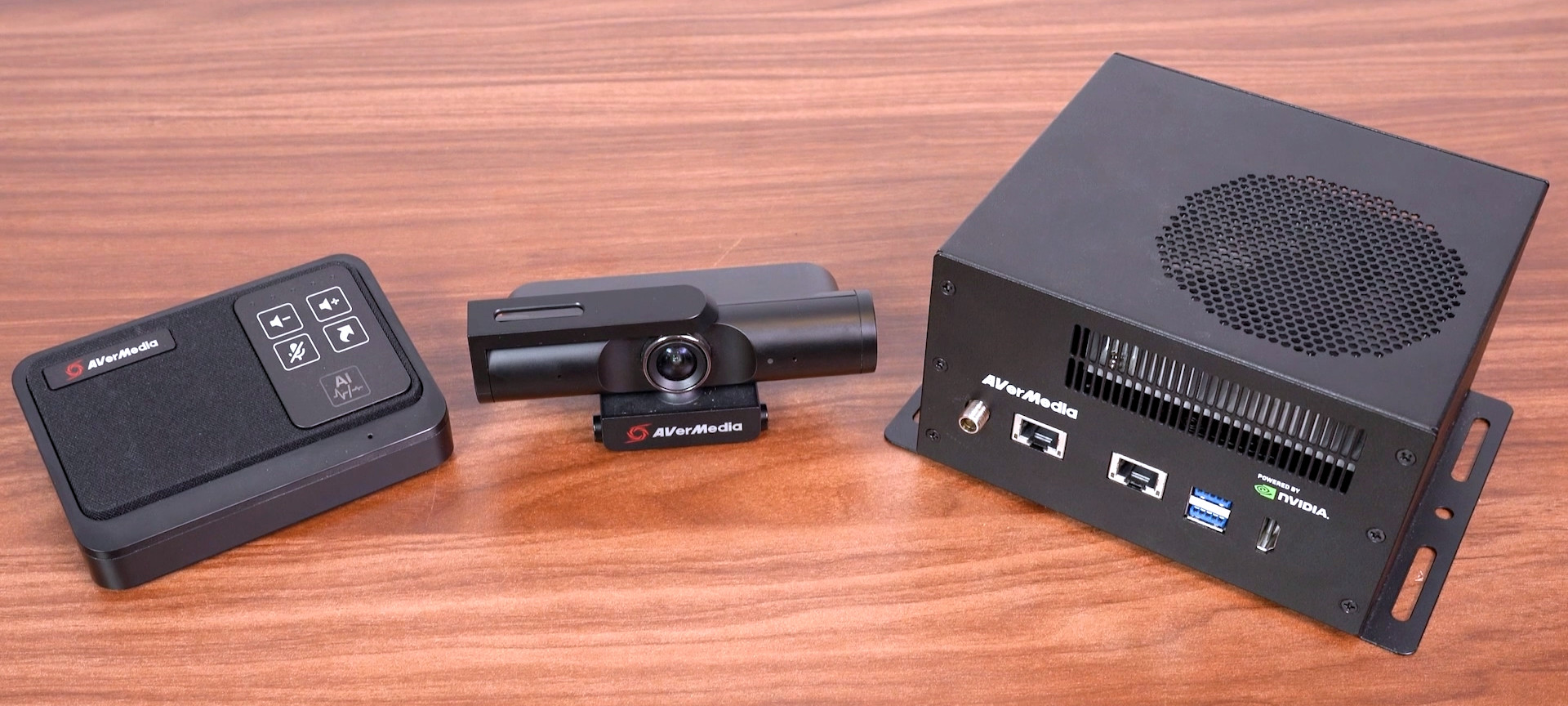
The AI Fusion Kit is designed to eliminate these challenges entirely. It is a complete, out-of-the-box solution where every component works seamlessly together.
AVerMedia AI Fusion Kit is an all-in-one solution for LLM/VLM developers. It consists of a powerful AI box PC, a 4K camera, and an AI speakerphone, allowing you to easily build your own multimodal AI applications. This guide will walk you through the steps to get started with the AI Fusion Kit.
AI systems demand increasing amounts of data to perform well—but gathering real-world data can be costly, slow, and limited in scope. That’s why many teams are turning to synthetic data: it’s faster to generate, easier to customize, and ideal for covering rare or hard-to-capture scenarios.
This blog shares our first hands-on experience with Tier IV’s Edge.Auto perception framework. After validating the perception modules in the CARLA simulator, we took the next step by deploying the same pipeline on the AVerMedia D135 embedded platform. This journey represents a practical attempt to bridge the gap between simulation and real-world deployment, helping us better understand how to run ROS 2-based perception logic on edge hardware.
This tutorial walks you through setting up an Autonomous Mobile Robot (AMR) using Jetson with the AVerMedia D115W platform and NVIDIA Isaac ROS. We cover sensor integration, depth estimation (ESS), Visual SLAM, costmap generation, and autonomous navigation with Nav2.
Time to First Token (TTFT) refers to the latency between a user hit the Enter key and the appearance of the first character shows on the screen. Excessive TTFT can greatly diminish the overall user experience.
TTFT is a crucial response time indicator for an online interactive application powered by a large language model (LLM), as it reflects how quickly users can catch the first character from the model through a web page.
Here, we will explore two simple ways to get the latency of first token from a language model.