Skip to content

Jetson

One Camera Leaves Gaps. Five Cameras Reveal the World.

A depth camera doesn't take a photograph. It builds a world — a dense cloud of points in 3D space, each one a precise distance measurement. Every surface, every edge, every object reduced to its position in space.

It's a remarkable way to see. The problem is the gaps.

A single camera captures what's directly in front of it. Everything else — the far side of an object, the space behind a surface, anything outside its field of view — simply doesn't exist in its picture of the world. Those invisible regions aren't a minor inconvenience. They're the difference between a system that understands a scene and one that only thinks it does.

That was true right up until multi-camera fusion stopped being a research problem — for a rig with its camera poses already known, it became a setup measured in minutes.
You Can Now Tell a Robot to Move — Powered by AgenticROS, NemoClaw, and the AVerMedia SenseEdge Development Kit

Say "move forward" to most AI-powered robots today, and nothing happens.

Not because the AI didn't understand you. It did. The model can parse the sentence, recognize the intent, even hold a conversation about what it plans to do next.

The robot just doesn't move — because understanding a command and acting on it are two completely different problems.

Accelerating Edge AI: Simplifying Camera Integration with AVerMedia

If you are developing an AI vision system, an autonomous mobile robot (AMR), or an edge-computing solution on a NVIDIA Jetson platform, camera-driver integration often becomes a bottleneck. Between sensor interfaces, kernel modules, device-tree overlays and tuning, teams can spend significant time just bringing up a simple camera feed. With AVerMedia’s Jetson-based systems the process is markedly streamlined. AVerMedia delivers camera drivers already integrated into its BSP (board-support-package) for Jetson modules so you can connect a supported camera and shift your focus quickly to perception, AI and deployment rather than low-level driver porting.

Benchmark SUPER mode of NVIDIA Jetson Orin NX

In 2025, AI is undoubtedly the hottest topic today, and there are many application scenarios that require localized deployment, such as smart surveillance systems, intelligent retail stores, and small-scale robots with LLM/VLM.

The NVIDIA Jetson Orin NX is a compact, high-performance AI computing module designed for edge applications such as robotics, smart cameras, and industrial automation. It delivers up to 157 TOPS of AI performance using the NVIDIA Ampere architecture, making it ideal for running complex AI models locally with low latency and high efficiency.

To unlock its full potential, the AVerMedia D133S Carrier Board provides a robust and versatile platform tailored for the Orin NX. It supports super mode for enhanced performance and offers a rich set of I/O.

Here, we are going to introduce and benchmark these two powerful standard carrier boards(D133 and D133S) from AVerMedia, which offer rich I/O options such as camera inputs, multiple Ethernet ports and a GPU, making them especially suitable for AI edge computing applications.

Accelerate VLM Development with AI Fusion Kit

AI Fusion Kit

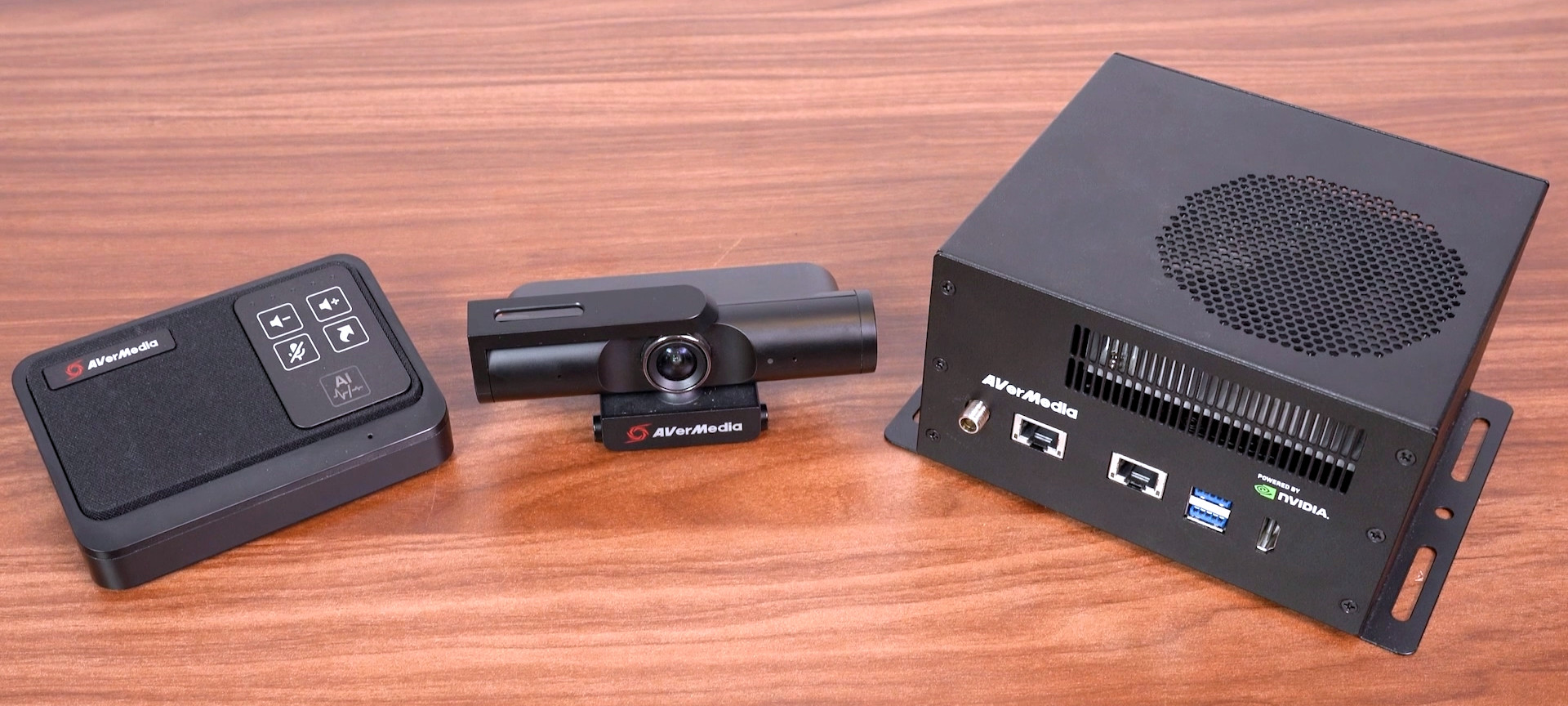
The first barrier in any multimodal LLM project is often not about the model itself, but about the hardware. Looking for a powerful computing platform, a high-quality camera, and a sensitive microphone can take a lot of time and effort. What's worse, these components may not work well together, leading to a tangled web of driver issues, compatibility conflicts, and frustrating debugging sessions before your real work even begins.

The AI Fusion Kit is designed to eliminate these challenges entirely. It is a complete, out-of-the-box solution where every component works seamlessly together.

Building a Resilient Smart Traffic Monitoring System on Jetson: Recovery via ERMI Virtual Media and API

Edge AI devices are increasingly used in smart traffic applications such as license plate recognition, vehicle flow analysis, and anomaly detection. However, real-world deployment challenges such as configuration corruption, system failure, or file damage can severely degrade device functionality. These issues are further complicated by the physical inaccessibility of many deployed systems.

We outline a practical, developer-oriented solution using ERMI (Edge Remote Management Interface) API and virtual media capabilities to enable remote recovery and minimize system downtime, set within the broader background of industry adoption of edge AI and remote management standards.

AI Fusion Kit Quick Start Guide

AVerMedia AI Fusion Kit is an all-in-one solution for LLM/VLM developers. It consists of a powerful AI box PC, a 4K camera, and an AI speakerphone, allowing you to easily build your own multimodal AI applications. This guide will walk you through the steps to get started with the AI Fusion Kit.

Porting Tier IV Edge.Auto to AVerMedia D135

This blog shares our first hands-on experience with Tier IV’s Edge.Auto perception framework. After validating the perception modules in the CARLA simulator, we took the next step by deploying the same pipeline on the AVerMedia D135 embedded platform. This journey represents a practical attempt to bridge the gap between simulation and real-world deployment, helping us better understand how to run ROS 2-based perception logic on edge hardware.

Installing Isaac ROS on Jetson

This article explains how to set up and install NVIDIA Isaac ROS on Jetson platforms, including Docker configuration, SSD integration, developer environment setup, and compatibility between different JetPack and Isaac ROS versions.