Accelerating Edge AI: Simplifying Camera Integration with AVerMedia
If you are developing an AI vision system, an autonomous mobile robot (AMR), or an edge-computing solution on a NVIDIA Jetson platform, camera-driver integration often becomes a bottleneck. Between sensor interfaces, kernel modules, device-tree overlays and tuning, teams can spend significant time just bringing up a simple camera feed. With AVerMedia’s Jetson-based systems the process is markedly streamlined. AVerMedia delivers camera drivers already integrated into its BSP (board-support-package) for Jetson modules so you can connect a supported camera and shift your focus quickly to perception, AI and deployment rather than low-level driver porting.
Pre-Integrated Camera Drivers for Jetson
AVerMedia’s embedded Jetson platforms are designed with camera readiness in mind. AVerMedia integrates camera support directly into the BSP for its Jetson platforms, so cameras are already configured and validated at the system level. The interfaces are tested across AVerMedia’s NVIDIA product lineup, and the software stack is kept in line with JetPack updates for Jetson Orin Nano, Orin NX, and AGX Orin.
Here are the key elements:
- Ready-to-use Driver Support: AVerMedia supports multiple camera interfaces such as MIPI CSI-2, USB and GMSL. The related drivers are included, so a supported camera works when connected to the Jetson board.
- Validated camera ecosystem: By partnering with camera manufacturers and lab testing, AVerMedia ensures the camera modules listed in its compatibility table are pre-validated for Jetson platforms.
- JetPack and SDK alignment: Because the integration is handled at the BSP level, developers can use NVIDIA’s standard tools such as GStreamer, V4L2 or DeepStream without custom driver work.
- Lower integration burden: The steps of bring-up (device tree, driver builds, sensor tuning) are handled by AVerMedia’s BSP. Engineers can spend their time on the vision pipeline, AI model and navigation logic instead.
Why It Matters for Developers
From a systems-engineering viewpoint camera integration touches many layers: sensor electrical interface, kernel driver, device-tree overlay, ISP or V4L2 pipeline tuning, firmware updates and compatibility with higher-level software such as ROS 2 nodes or DeepStream components. When that stack is ready out-of-the-box you gain several advantages:
- Faster time to market: Instead of spending days or weeks on camera driver porting and validation, you start sooner with image acquisition, preprocessing and algorithm development.
- Greater system stability: Drivers and board bring up are pre-tested under real-world edge conditions (temperature, vibration, multi-camera setups, high data rates) by AVerMedia and partner teams.
- Focus on your value-add work: With the low-level integration solved, your team can concentrate on the modules that differentiate: perception models, data fusion, reliability in deployment, monitoring, SLAM and navigation.
- Consistency across updates: As JetPack evolves, AVerMedia’s BSPs are updated accordingly so camera integrations remain supported, and you avoid the scenario where a camera worked in a dev kit but fails in production.
Use Case: Seamless AI for Robotics with Stereolabs
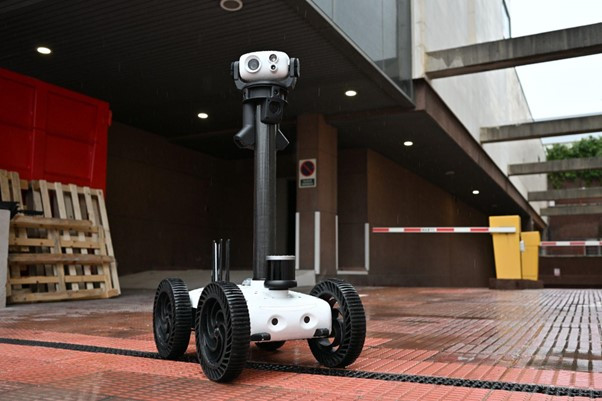
Star Robotics's Watchbot, an autonomous robot with a ZED X camera and D315 board, performs 24/7 surveillance and hazard detection
A practical example is shown in the Solving Vision Integration at the Edge: Seamless AI for Robotics. In that project:
- A fleet of autonomous robots used a stereo camera (Stereolabs ZED X) connected to an AVerMedia carrier board built for a Jetson AGX Orin module.
- Because the camera drivers and board interface were pre-validated and integrated, the development team did not need to source custom drivers, patch SDKs or modify the BSP. They succeeded in “booting into a working configuration with pre-validated firmware and software compatibility already in place.”
- The result: thousands of hours of autonomous patrols, kilometers travelled and reliable vision navigation under challenging edge conditions (rain, fog, direct sunlight).
This real-world example demonstrates how a validated camera + Jetson platform stack accelerates field-deployment and reduces risk in robotics or edge-computing use-cases where time to reliability is critical.
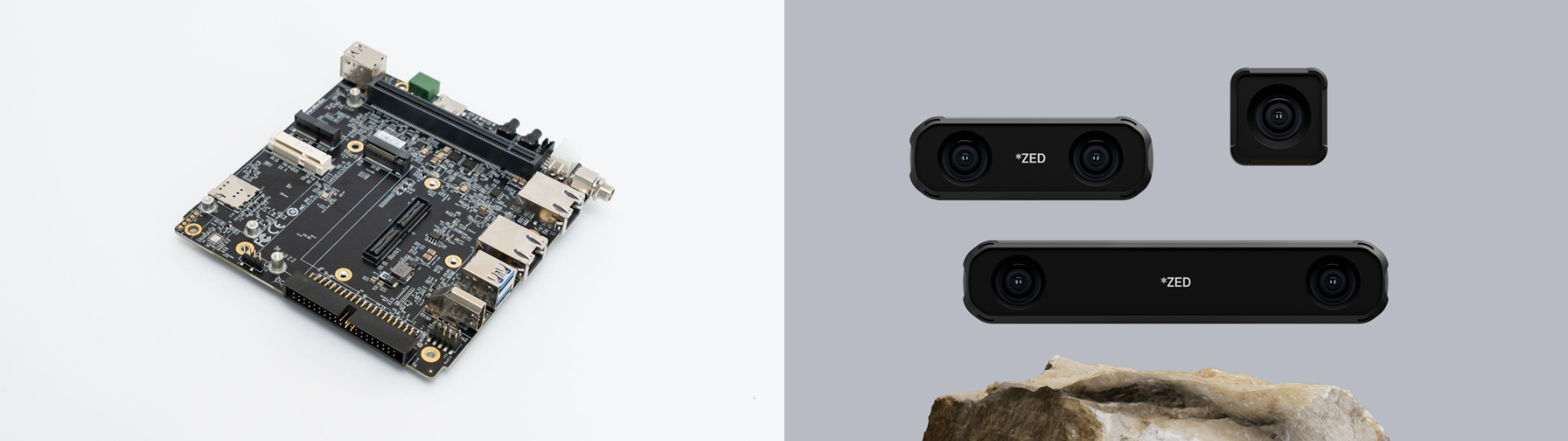
(Left) The D315 board from AVerMedia. (Right) The Zed X One Camera from Stereolabs.
Conclusion and Developer Resources
For embedded-system developers working on Jetson-based vision or robotics projects, choosing a platform where camera drivers are pre-integrated brings tangible benefits: less bring-up risk, faster startup and more time available for innovation. If you are working with Jetson Orin Nano, NX, or AGX Orin modules and want to bypass driver integration and go straight to your vision logic, AVerMedia’s platforms are worth serious consideration.
Check out the full list of supported and validated cameras, view the compatibility table and select modules confidently for your next Jetson-based deployment.